Jev: a model that returns decisions, not text
TypeSafe's Jev answers classification questions with structured decisions, not text. What it is, how it works, and where I'd use it.
Why would you want a model that doesn’t generate text? Meet Jev, from TypeSafe.
What it is
Jev is TypeSafe’s new flagship model for classification and decision-making. You give it unstructured information and a typed question, and it returns a structured decision your software can use directly, with no text generation or parsing in between.
Jev answers three types of question:
| Question type | Goal | Returns |
|---|---|---|
| Choice | Choose an option from a list | choice, probabilities, confidence |
| Score | Score the state on a rubric | score, probabilities, confidence |
| Noul | Is this statement true? | noul (0–1) |
Every Choice and Score answer comes with a confidence score. Set a threshold on it to decide whether to automate the action or route it to a human for review, which simplifies a human-in-the-loop workflow.
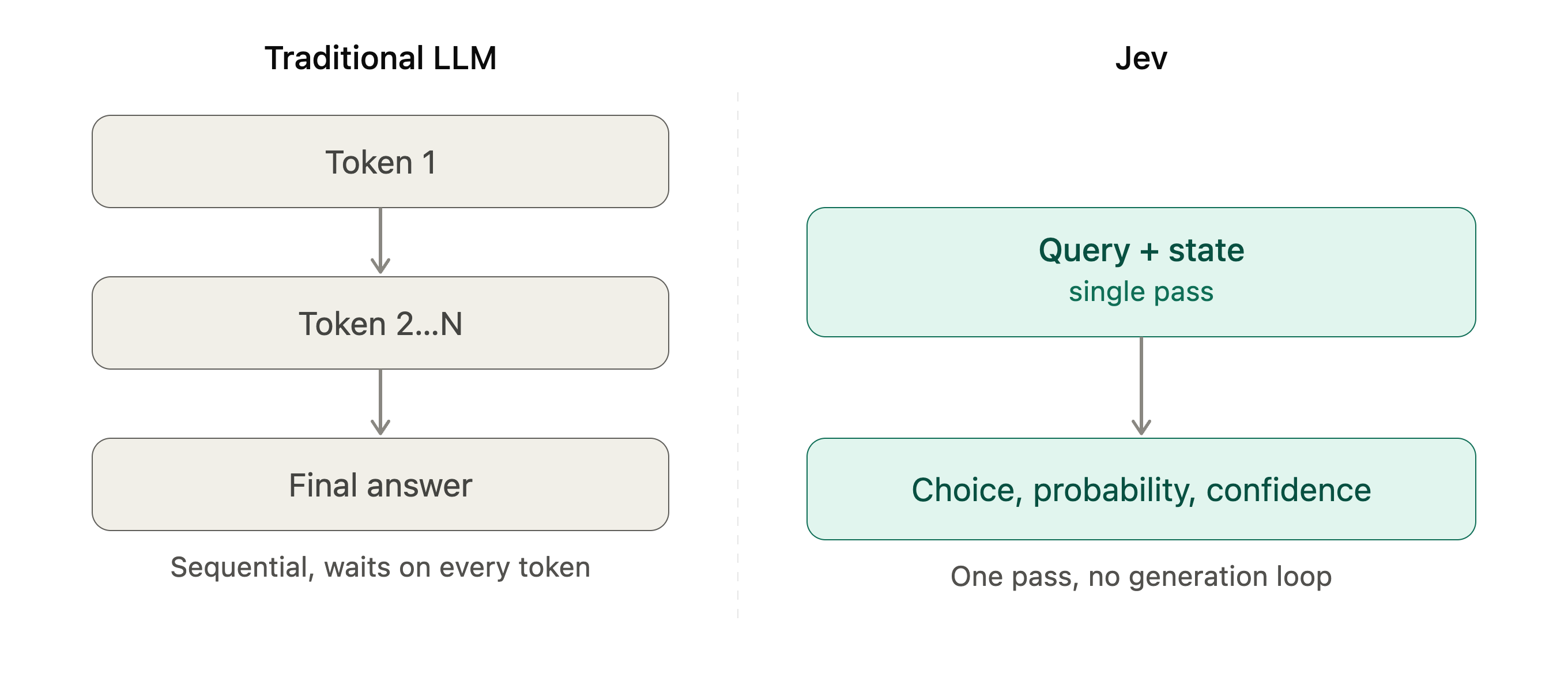
Like an LLM, Jev takes natural language as input. Unlike an LLM, it returns a classification and probabilities, not text.
Even better, it processes each choice in parallel instead of generating an answer one token at a time. In TypeSafe’s own benchmarks, that made it up to 193.6 times faster and 444.6 times cheaper than the LLMs they tested, though TypeSafe says those numbers are on the high end of real-world gains.
Why this matters
Classification models have always existed, but they required you to collect labeled examples and train on them, and adding a new classification option meant retraining the model with new labeled examples. Jev is a general-purpose classifier: to change what it classifies, update the question type or the choices you send to Jev.
That lets teams change a classification by editing the choices they send instead of waiting on a training cycle, so they can spend their time and resources solving problems instead of building or optimizing new classifiers. And instead of sending a classification decision to an LLM, agents and APIs can now send it to Jev, then use the returned choice along with its confidence to make decisions.
Who is using it now
TypeSafe released Jev in early access on September 15th, and within days it was showing up across the industry. It’s available on Cloudflare and Vercel, LangChain published a guide to building an agent harness with it, and Langfuse added support for using it as an evaluator.
Where you’d actually use it
I plan to do more tests and proof of concepts soon. Here are a few ideas I have off the top of my head.
In e-commerce, Jev could classify search intent in real time and route shoppers to the right experience based on their history, location, or query. Teams already do this, but slow search directly hurts revenue, so a fast classifier matters.
In finance, it could power mortgage pre-qualification: score an applicant’s details against strict criteria and return a decision instantly.
In telecom and customer support, it’s a cheaper way to track sentiment in chat logs, or to score which customers are most likely to accept an offer.
I already have a few projects in mind where Jev would be great for grouping content into categories; maybe I’ll make a blog post specifically about them.
The takeaway
A lot of what we ask LLMs to do isn’t writing, it’s deciding: route this request, tag this ticket, is this tool call safe? When you don’t need text back, a model that returns a decision, with a confidence score you can act on, should be faster and cheaper, according to TypeSafe’s own benchmarks.
Where in your stack is an LLM picking from a list of options? Those are the calls worth swapping first.